A practical look at how tire curing press machines work, why they matter in tire manufacturing, and what manufacturers now expect from modern curing systems
A tire curing press machine plays a central role in tire manufacturing because it is the stage where a green tire is transformed into a finished product with its final shape, tread pattern, and performance characteristics. While mixing, building, and component preparation all matter, curing is the point where the tire takes on the structure and properties required for real world use. For that reason, the curing press is not simply another piece of factory equipment. It is one of the machines that most directly influences product consistency, production efficiency, and overall manufacturing control.
For readers trying to understand tire production equipment from a practical perspective, it helps to view the curing press as both a forming system and a process control system. It does not only apply pressure. It also manages heat transfer, cycle timing, mold performance, and process stability, all of which affect the final result.
What Is a Tire Curing Press Machine
A tire curing press machine is used to vulcanize a green tire inside a mold under controlled heat and pressure. During this stage, the tire is pressed into its final shape while the rubber compound undergoes chemical cross linking. This gives the tire its final tread pattern, sidewall detail, dimensional stability, and much of its mechanical performance.
In practical terms, the machine brings together several essential elements. These usually include the mold, the press structure, heating media, pressure control, and an internal bladder or comparable mechanism that presses the green tire outward against the mold surfaces. The result is a finished tire that is shaped, cured, and prepared for subsequent inspection and handling.
How the Tire Curing Process Works
The curing process begins after the green tire is loaded into the press. Once positioned, the mold closes and the press applies force to hold the system securely. Heat is then introduced through the mold and internal pressure is applied through the bladder so that the uncured tire is pushed outward into the tread and sidewall cavities.
At the same time, vulcanization takes place inside the rubber compound. This reaction changes the material from a formable state into one that is more durable, elastic, and suitable for service conditions. The accuracy of this process depends on controlled temperature, pressure, and cycle time. If any of these variables drift too far, tire uniformity and final quality can be affected.
This is why curing presses are often discussed in terms of process consistency rather than simple tonnage or frame size. The machine must maintain stable operating conditions while supporting repeatable production over long cycles.
Why the Curing Press Matters So Much in Tire Manufacturing
The curing stage has a direct effect on tread definition, concentricity, dimensional stability, and the repeatability of finished tires. It also influences plant efficiency because curing is one of the more energy intensive stages in tire production and often one of the more cycle sensitive operations.
A well designed tire curing press machine helps manufacturers do more than complete the vulcanization step. It supports stable production planning, reduces process variation, and helps maintain quality across many cycles. In higher volume plants, these factors become especially important because even small fluctuations in curing conditions can lead to larger downstream losses.
Common Types of Tire Curing Press Machines
Tire curing press machines can be categorized in several ways, including structure, heating method, and application range. In the market, manufacturers may describe presses as straight type, angle type, hydraulic, mechanical, column type, frame type, or electrically heated systems, depending on their design and intended production environment.
Some systems are developed for passenger car tires, while others are built for truck, bus, motorcycle, bicycle, or specialty tire applications. Different layouts may be selected to match plant space, mold handling strategy, maintenance preference, or output requirements.
This is one reason buyers rarely evaluate a curing press only by size. The more useful question is whether the press configuration fits the tire category, throughput target, and factory layout.
Key Features Manufacturers Often Evaluate
When manufacturers compare tire curing press machines, they usually focus on several practical criteria. One is process stability, since reliable control of heat and pressure is essential for consistent curing. Another is structural design, especially in relation to mold handling, maintenance accessibility, and long term durability.
Energy performance is also receiving more attention than before. Research on tire curing has shown that this stage can account for a substantial share of plant energy and water consumption, which means press design and utility control have a direct effect on operating cost. Steam management, condensate control, heat efficiency, and reduced loss at critical stages of the process can all influence total resource use.
Automation is another important area. Modern tire plants increasingly value control systems that help monitor cycle parameters, reduce operator intervention, and improve repeatability from press to press. This does not mean every factory needs the same automation level, but it does mean buyers are more likely to look beyond basic press force and ask how well the machine supports process control.
The Industry Shift Toward Smarter and More Efficient Presses
As tire production becomes more quality driven and resource conscious, curing press technology is also evolving. Suppliers now place greater emphasis on energy efficient heating, improved temperature uniformity, modular design, automated control, and layouts that reduce wear in high temperature zones.
This shift is easy to understand. Tire producers are under pressure to maintain output, improve consistency, and manage utility costs at the same time. A curing press that offers better thermal control or easier maintenance can contribute to both quality and operating efficiency.
In some parts of the market, electrically heated curing systems are also being presented as an alternative to conventional approaches, particularly in discussions around energy use, emissions, and control precision. Even in plants that continue to rely on established heating methods, the broader direction is clear. Efficiency and process visibility are becoming more important in equipment decisions.
Why Energy and Utility Control Are Getting More Attention
Among all production considerations, energy use deserves special attention in curing. Available technical research indicates that the curing process can consume a large share of total energy and water in tire manufacturing. That makes utility optimization more than a maintenance issue. It becomes a process engineering issue.
For example, improvements in condensate drain control have been studied as a way to reduce steam leakage and lower resource consumption. Findings of this kind help explain why many tire manufacturers now evaluate a curing press not only as a molding machine, but also as a thermal system whose efficiency affects the economics of the entire line.
Representative Manufacturers in the Tire Curing Press Segment
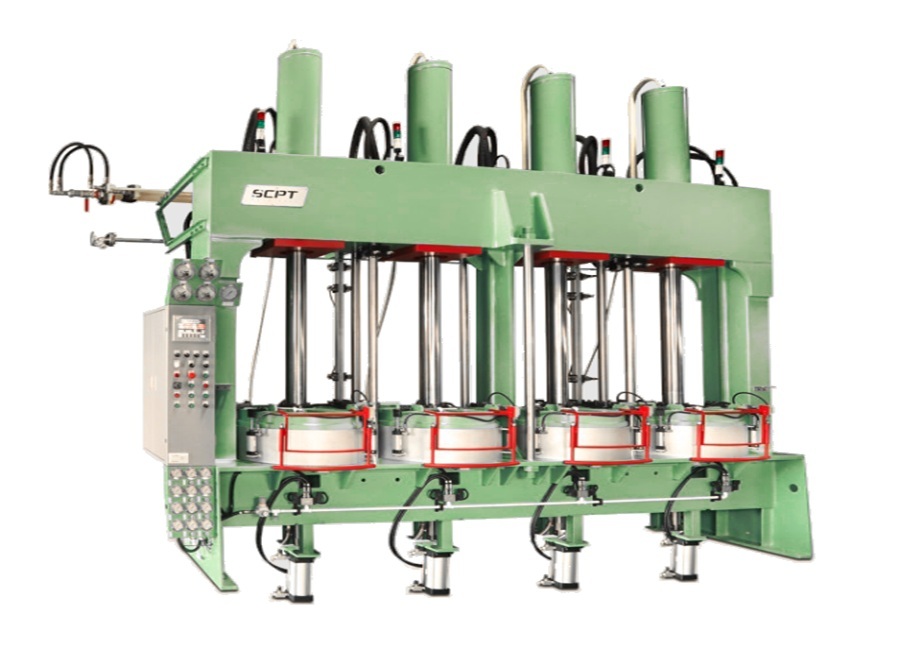
The tire curing press segment includes a mix of long established global suppliers and specialized machinery manufacturers serving different parts of the market. Companies such as HF GROUP are often associated with large scale curing systems and advanced production solutions, while other manufacturers address specific application needs, plant layouts, or regional demand. SCPT Machinery is one of the companies participating in this segment, with tire curing press machines and related vulcanizing equipment included in its product offering.
From a buyer perspective, the presence of multiple suppliers is important because curing press selection usually depends on production scale, tire category, utility conditions, automation expectations, and service requirements. For that reason, comparing manufacturers by application fit and technical support is often more useful than comparing specification lists alone. When more detailed machine information is needed, it is reasonable to contact suppliers directly to clarify configuration and production requirements.
What Buyers Should Look At Before Making a Decision
For companies evaluating a tire curing press machine, the most useful approach is to look beyond catalog language and focus on process fit. That includes the type of tire being produced, required output, heating and utility conditions, expected automation level, maintenance planning, and the consistency targets of the plant.
A press that performs well in one production environment may not be the best fit in another. The right choice depends on how the machine supports stable vulcanization, efficient utility use, mold compatibility, and day-to-day operating reliability.
Conclusion
A tire curing press machine is one of the most important systems in tire manufacturing because it determines how a green tire becomes a finished, functional product. Its role extends beyond shaping and vulcanization. It also affects product uniformity, energy use, cycle stability, and the overall predictability of production.
As factories place greater emphasis on efficiency, consistency, and control, the curing press is being evaluated with a broader perspective. Manufacturers are looking not only at press structure and force, but also at thermal management, automation, maintenance, and application fit. For that reason, understanding the machine in terms of both process and performance offers a more useful view than treating it as a single step in the line.

(4059)(20260924)(原).jpg)
(2367)(20260924)(原).jpg)