Why Choosing Between a Knee Mill and a CNC Bed Mill Matters
When companies evaluate milling equipment, one of the most common questions is: should we choose a knee mill or a cnc bed mill?
On the surface, both are milling machines. But once the discussion moves into real production conditions, order patterns, workpiece requirements, and operator environments, the difference between the two becomes much more significant.
For procurement teams, factory owners, production managers, and equipment planners, this is not only a technical comparison. It is also a business decision that can directly affect:
- machining stability
- part quality
- production efficiency
- setup and changeover time
- return on equipment investment
- future order-taking flexibility
Some factories mainly handle prototyping, repair work, high-mix low-volume production, and flexible operations. In those cases, a knee mill may be the better fit. However, if a factory often machines heavier workpieces, requires stronger cutting stability, or wants to improve consistency in repeat production, a cnc bed mill is often the more suitable option.
This article explains the structural difference between a knee mill and a bed mill, outlines the strengths and use cases of each type, and provides a practical framework for deciding which machine is better for your workflow. From a third-party industry content perspective, this article also helps readers move from simply “looking at specifications” to making a more informed equipment decision.
Why This Comparison Matters for Buyers and Factory Managers
Many equipment purchasing mistakes do not mean the machine is completely unusable. More often, the problem is that the machine seems usable at first, but proves to be a poor fit over time. For example:
- it can machine parts, but the productivity is not ideal
- it can run, but repeat accuracy is not stable enough
- it can take orders, but setup and changeover take too long
- it can process jobs, but output depends too heavily on highly experienced operators
- it solves a short-term need, but limits long-term factory growth
That is why, when comparing a knee mill and a cnc bed mill, buyers should not ask only, “Which one is better?” They should ask:
- What are the typical size and weight of our workpieces?
- Are we running high-mix low-volume jobs or fixed batch production?
- Do we need flexibility more, or rigidity and stability more?
- Is operator skill level consistent across shifts?
- Is this machine meant only to solve today’s issue, or also to support future growth?
Once these questions are clarified, machine selection becomes much more practical and much less dependent on surface-level catalog comparison.
What Is a Knee Mill?
A knee mill is a milling machine in which the worktable is mounted on a vertically adjustable knee. In simple terms, the worktable that holds the part can move up and down along the column, which gives the machine greater operating flexibility.
Knee mills are commonly used in:
- toolrooms
- maintenance departments
- custom machining environments
- prototyping and trial production settings
- technical education and training institutions
- small machining shops
This machine type has remained popular for a reason: it offers strong versatility. For work environments that need to change parts often, adjust machining methods frequently, or respond to urgent tasks, a knee mill is still highly practical.
A knee mill is especially valuable in situations such as:
- repair part machining
- prototyping and sample cutting
- fixture adjustment
- one-off customized parts
- urgent short-lead jobs
- small-batch production
In other words, if your workflow is not centered on long-run, large-batch, fixed-process production, but instead focuses more on flexibility and variation, a knee mill can still be a very reasonable and cost-effective choice.
What Is a Bed Mill?
A bed mill follows a different structural concept. Compared with a knee mill, where the table moves vertically with the knee, a bed mill typically keeps the table more fixed in the vertical direction, while the spindle head or milling head moves up and down.
The biggest result of this structure is that the overall rigidity is usually higher. Because of that, a bed mill is generally better suited for:
- heavier workpieces
- larger fixtures
- higher cutting loads
- more stable machining conditions
When combined with CNC control, forming what is commonly called a cnc bed mill, this machine type becomes especially suitable for:
- repeat production
- medium- to long-run batch machining
- heavier workpiece support
- more stable machining quality
- reducing quality variation between operators
- improving parameter consistency across jobs
If the main strength of a knee mill is flexibility, the core value of a cnc bed mill is stability, rigidity, and production consistency.
Knee Mill vs Bed Mill: What Is the Most Important Difference?
The biggest difference between these two machine types is not just the name. It is the logic of vertical movement and support structure:
- Knee mill: the worktable moves up and down with the knee structure
- Bed mill: the table remains more fixed vertically, while the spindle head moves up and down
This structural difference directly affects:
- machine rigidity
- vibration resistance
- workpiece load capacity
- heavy cutting performance
- machining stability
- suitability for large or heavy parts
- operating feel and changeover flexibility
For buyers without a deep machining background, a simple way to understand it is:
- a knee mill is more like a flexibility-oriented machine
- a cnc bed mill is more like a stability-oriented machine
Neither is automatically better. The right answer depends on which one better matches your workflow.
Quick Comparison Table: Knee Mill vs CNC Bed Mill
Before going deeper into real-world applications, the following table offers a quick side-by-side comparison. It can be useful for procurement teams and management as an initial screening reference.
| Comparison Factor |
Knee Mill |
CNC Bed Mill |
| Structure |
Table moves vertically on the knee |
Table remains more fixed vertically; head moves up/down |
| Machine rigidity |
Medium |
Higher |
| Suitable workpiece size |
Small to medium |
Medium to large |
| Suitable workpiece weight |
Lighter workpieces |
Heavier workpieces |
| Operating flexibility |
High |
Medium to high |
| Manual or semi-manual suitability |
Very high |
Relatively lower |
| Repeat production performance |
Acceptable for lighter tasks |
Better for stable production |
| Heavy cutting capability |
Lower |
Better |
| Initial investment level |
Usually lower |
Usually higher |
| Common use scenarios |
Toolroom, repair, prototyping |
Production, industrial parts, stable machining |
This table is a useful starting point, but real machine selection should still be based on workpiece conditions, production patterns, and business growth strategy.
When Does a Knee Mill Make More Sense?
For many small and medium-sized factories, a knee mill is far from outdated. In fact, it remains highly practical in many situations, especially when the workflow is defined by high variability.
Common situations where a knee mill is a good fit:
- high-mix low-volume machining
- prototyping and trial production
- repair part manufacturing
- mold or fixture correction work
- toolroom operations
- training environments
- factories with limited budgets that still need versatile equipment
For example, if a shop mainly handles custom parts, urgent repair items, and sample cutting, buying a machine optimized for batch production and heavier workpieces may not create the best return. In that case, the true bottleneck is not rigidity, but whether the machine can respond quickly to changing tasks.
The advantages of a knee mill in such cases include:
- more flexible setup adjustment
- faster response to urgent or changing jobs
- lower initial investment
- better handling of varied tasks throughout the day
- especially useful for toolroom and maintenance work
So, if flexibility and responsiveness are the main priorities in your workflow, a knee mill may offer better practical value than a heavier and more production-centered machine.
When Does a CNC Bed Mill Make More Sense?
When a factory’s production model is closer to stable batch output, heavier workpieces, or tighter consistency requirements, the advantages of a cnc bed mill become clearer.
Common situations where a cnc bed mill is a good fit:
- repeat machining of standard parts
- medium- to long-run production orders
- larger or heavier workpieces
- processes that require stronger rigidity and stability
- production lines sensitive to yield and consistency
- operations that want to reduce quality variation caused by operator differences
This type of machine is preferred by many industrial users because it can support heavier cutting loads more reliably and maintain better quality consistency across repeated batches.
For factory managers, the value goes beyond pure cutting capability. It also contributes to broader operational benefits, such as:
- reducing rework and scrap risk
- improving batch production stability
- lowering dependence on a few highly experienced operators
- reducing quality variation between shifts
- increasing order-taking capability and equipment utilization
If a factory wants equipment that not only solves current orders but also supports future opportunities with higher-specification customers, a cnc bed mill is often the more expandable choice.
Do Not Look Only at Price—Look at Total Cost
When companies purchase equipment, the first thing many people notice is the price. That is understandable. However, if buyers focus only on the initial purchase amount, they often make the wrong decision.
What truly affects return on investment is not just how much the machine costs to buy, but whether it can continue creating stable value over the coming years.
If the wrong machine is selected, the hidden costs may include:
- poor production rhythm
- longer setup time
- unstable yield
- increased rework
- poor surface quality
- weaker dimensional consistency
- limited ability to accept higher-specification orders
That is why the better question is:
Which machine type best matches our workpiece conditions, operating model, workforce structure, and future business direction?
Only when the equipment truly matches the workflow does a lower price become a real cost advantage. Otherwise, it simply delays bigger problems.
Market Trends: Why CNC and Milling Equipment Selection Still Matters
Looking at the global machine tools market, manufacturers continue to place higher value on CNC capability and machining stability. According to Mordor Intelligence, the global machine tools market is expected to continue growing over the coming years, and CNC-related equipment still accounts for a major share of market demand. This reflects the fact that manufacturers are increasingly prioritizing:
- production consistency
- automation and digital control capability
- machining efficiency
- capacity utilization
- process stability after workforce changes
In other words, comparing a knee mill with a cnc bed mill today is not only about comparing two machine types. It is also about deciding how a company should structure its machining capacity to meet future market expectations for higher efficiency, better quality, and greater flexibility.
How to Decide: A Practical Framework for Buyers and Factory Leaders
If you are currently comparing a knee mill and a cnc bed mill, the following framework can help guide the decision.
1. Start with workpiece conditions
Clarify the following points:
- How large are the workpieces in most cases?
- What weight range do they usually fall into?
- Are large fixtures commonly used?
- Are the cutting conditions relatively demanding?
If the workpieces are lighter and vary often, a knee mill may be enough.
If the workpieces are heavier, use larger fixtures, or involve heavier cutting, a cnc bed mill is usually the better option.
2. Review your production model
Confirm the following:
- Is your production high-mix and low-volume?
- Or is it based on fixed batches and repeated long-term production?
- How often do jobs change during the day?
High-variation workflows often favor a knee mill.
Stable repeat production usually favors a cnc bed mill.
3. Evaluate workforce structure
Think about these questions:
- Does output quality depend heavily on a few specific operators?
- Is there significant quality variation between shifts?
- Does the company want to improve process standardization?
If the company wants to reduce operator-related variation and improve repeatability, a more stable CNC-based structure is usually more beneficial.
4. Do not ignore future growth
Machine tools are long-term assets. So buyers should ask:
- Will we likely take on larger workpieces in the future?
- Are there plans to expand production capacity?
- Do we want to enter higher-specification markets?
If the answer is yes, then machine selection should not be based only on today’s minimum requirement. It should also reflect future flexibility.
Conclusion
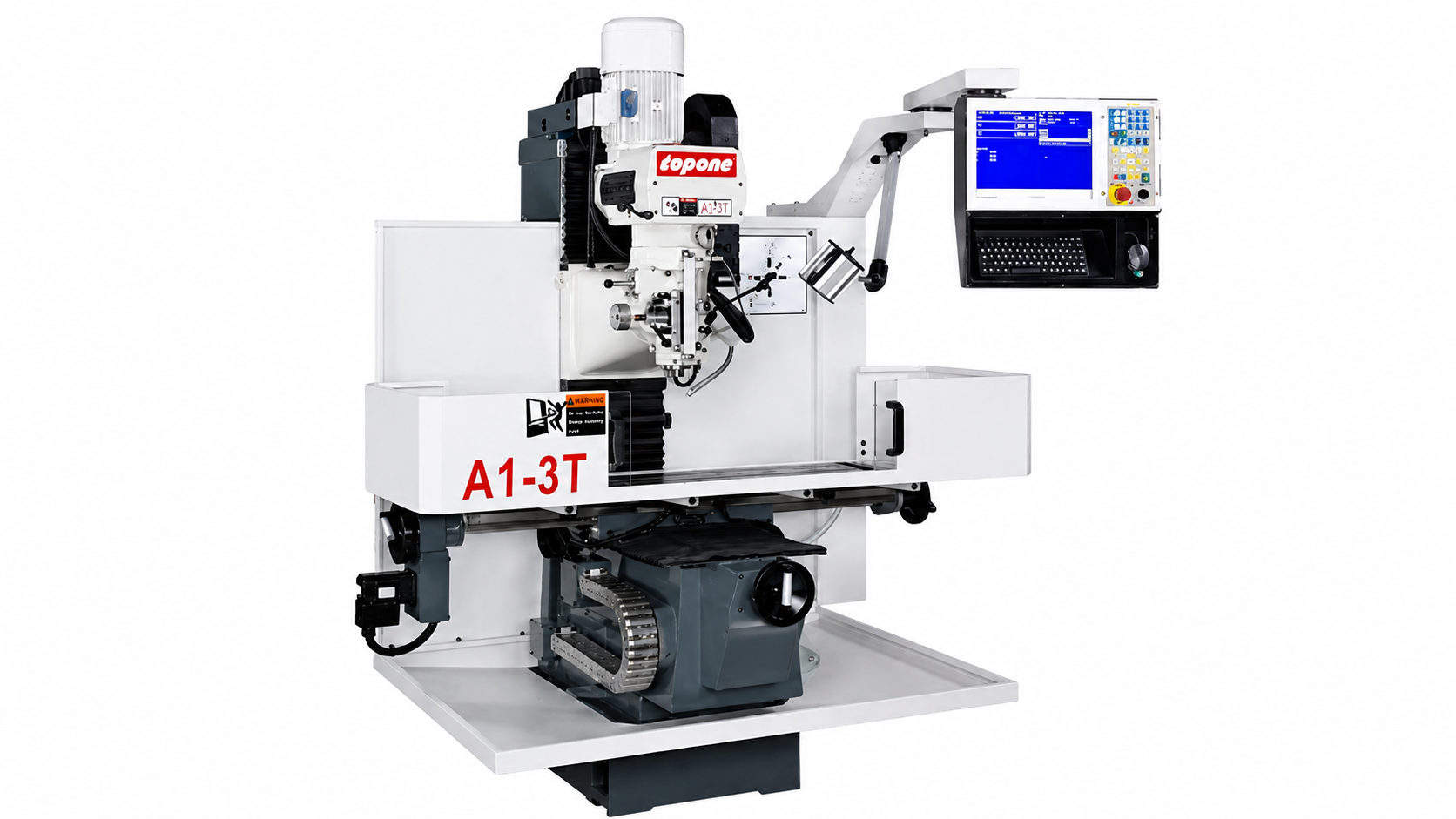
In the end, the choice between a knee mill and a cnc bed mill depends on your actual workflow, part size, production volume, and machining priorities. If your operation focuses more on flexible setups, repair work, prototyping, and high-mix low-volume jobs, a knee mill may be the more practical fit. If you need stronger rigidity, better support for heavier workpieces, and more stable repeat production, a cnc bed mill is often the better long-term option. For buyers who want to move from comparison to real machine evaluation, reviewing actual product categories can be a useful next step. TOP-ONE MACHINERY CO., LTD. offers both Vertical Knee Milling Machines and CNC Bed Mills, giving readers a practical reference point when matching machine type to production needs.

(4059)(20260924)(原).jpg)
(2367)(20260924)(原).jpg)