Transforming Healthcare With AI, MODERNSOLID Offers Telemedicine Cart-Physicians Preferable Flexible Solution
Firm News

Transforming Healthcare With AI, MODERNSOLID Offers Telemedicine Cart-Physicians Preferable Flexible Solution

Artificial intelligence (AI) has the potential to transform how healthcare is delivered. A joint report with the European Union’s EIT Health explores how it can support improvements in care outcomes, patient experience, and access to healthcare services.
Published: Jul 29, 2020
Transforming Healthcare With AI, MODERNSOLID Offers Telemedicine Cart-Physicians Preferable Flexible Solution

AI in healthcare today

It can increase productivity and the efficiency of care delivery and allow healthcare systems to provide more and better care to more people. AI can help improve the experience of healthcare practitioners, enabling them to spend more time in direct patient care and reducing burnout.

Healthcare is one of the major success stories of our times. Medical science has improved rapidly, raising life expectancy around the world, but as longevity increases, healthcare systems face a growing demand for their services, rising costs and a workforce that is struggling to meet the needs of its patients.

Demand is driven by a combination of unstoppable forces: population aging, changing patient expectations, a shift in lifestyle choices, and the never-ending cycle of innovation being but a few. Of these, the implications from an aging population stand out. By 2050, one in four people in Europe and North America will be over the age of 65—this means the health systems will have to deal with more patients with complex needs. Managing such patients is expensive and requires systems to shift from an episodic care-based philosophy to one that is much more proactive and focused on long-term care management.

Healthcare spending is simply not keeping up. Without major structural and transformational change, healthcare systems will struggle to remain sustainable. Health systems also need a larger workforce, but although the global economy could create 40 million new health-sector jobs by 2030, there is still a projected shortfall of 9.9 million physicians, nurses, and midwives globally over the same period, according to the World Health Organization. We need not only to attract, train, and retain more healthcare professionals, but we also need to ensure their time is used where it adds most value—caring for patients.

Building on automation, artificial intelligence (AI) has the potential to revolutionize healthcare and help address some of the challenges set out above. There are several definitions of AI, but this report draws from a concise and helpful definition used by the European Parliament, “AI is the capability of a computer program to perform tasks or reasoning processes that we usually associate with intelligence in a human being.” AI can lead to better care outcomes and improve the productivity and efficiency of care delivery. It can also improve the day-to-day life of healthcare practitioners, letting them spend more time looking after patients and in so doing, raise staff morale and improve retention. It can even get life-saving treatments to market faster.

The growing number of use cases

These illustrate the full range of areas where AI can have an impact: from apps that help patients manage their care themselves, to online symptom checkers and e-triage AI tools, to virtual agents that can carry out tasks in hospitals, to a bionic pancreas to help patients with diabetes. Some help improves healthcare operations by optimizing scheduling or bed management, others improve population health by predicting the risk of hospital admission or helping detect specific cancers early enabling intervention that can lead to better survival rates; and others even help optimize healthcare R&D and pharmacovigilance. The scale of many solutions remains small, but their increasing adoption at the health-system level indicates the pace of change is accelerating. In most cases, the question is less whether AI can have an impact, and more on how to increase the potential for impact and, crucially, how to do so while improving the user experience and increasing user adoption.

Physicians preferable flexible solution

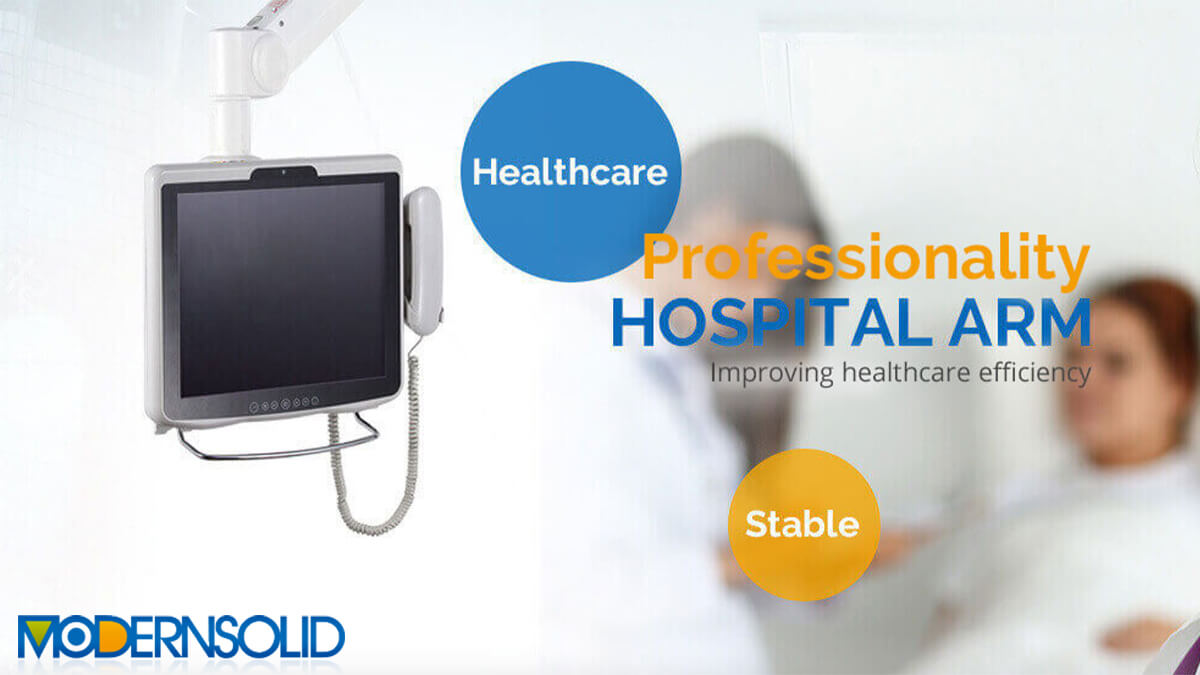
Telemedicine Cart

MODERNSOLID designs and manufactures a wide range of Mounting Solutions that create comfort and healthy workspace for various application areas since 1988.

With the insistence on the ergonomics and high quality, not only received ISO 2015 but also cooperated with TÜV Rheinland Group to develop global test regulations. Today MODERNSOLID has grown to be a world-leading supplier in all kinds of mounting solutions for LCD monitors, notebooks, large flat panel displays among office, industrial, education, and healthcare markets.

They provide full ranges of accessories for our carts to achieve the ideal telemedicine cart that meets customer's demand. It is applicable in medical, education, household, and more. If you have any questions or cooperation, please contact MODERNSOLID.

Published by Jul 29, 2020 Source :modernsolid Source :mckinsey

Further reading

You might also be interested in ...

Headline
Firm News
EXCETEK Showcases Smart Flexible Manufacturing at TMTS 2026: Advancing Precision EDM, Automation and Sustainable Production
Published for precision manufacturing, EDM and smart factory audiences
Headline
Firm News
The Intersection of Smart Security and Green Sustainability: SINOX's Vision at COMPUTEX Taipei 2026
Sinox showcases the future of smart device security at Computex 2026 with its RL3018 and RL3017 universal locks, seamlessly integrating cutting-edge asset protection with a firm commitment to ESG and green sustainability.
Headline
Firm News
A New Route for Textile Waste: Recycled Cotton Enters Lyocell Filament Production
By transforming difficult-to-recycle textile waste into high-value lyocell filament, this development demonstrates how recycled cotton can support more circular material solutions and drive innovation in sustainable fiber production.
Headline
Firm News
From Standalone Machines to Integrated Production Lines: A New Direction for Coil Winding Automation
Coil winding automation is moving beyond the performance of individual machines. As production environments become more demanding, many of the most persistent problems no longer come from winding speed alone, but from poor coordination between processes, inconsistent material flow, and production layouts that were never designed to operate as one connected system. Integrated production lines are gaining attention because they address the broader structure of winding operations rather than only improving one isolated step.
Headline
Firm News
DYCUP to Showcase Customized Food Packaging Solutions at NRA Show 2026 in Chicago
Taiwan-based manufacturer DYCUP will exhibit at Booth 455, South Building, presenting a wide range of custom and eco-friendly food packaging products for the global foodservice industry.
Headline
Firm News
From Bearing Parts to Custom Metal Parts: Chin Sing Expands Its Manufacturing Capabilities
As industrial sourcing needs become more specialized, manufacturers are placing greater value on suppliers that can support both standard components and drawing-based production. Chin Sing’s expanded manufacturing scope reflects this shift from product supply toward broader precision support.
Headline
Firm News
GaleMed Introduces BioVent-Circuit® at MEDICA 2025: Advancing Sustainable Respiratory Care
As environmental expectations rise across healthcare, GaleMed is bringing a lower-carbon breathing circuit to the global stage. BioVent-Circuit® is designed to combine practical performance with a more transparent sustainability profile.
Headline
Firm News
Business Weekly Features SUCOOT: Construction Safety and Engineering Integration Gain Market Attention
For project owners, procurement teams, contractors, and engineering managers, scaffolding and temporary support systems are no longer evaluated as material purchases alone. In public infrastructure, high-tech facilities, industrial projects, and specialized restoration works, supplier selection is often influenced by structural stability, load-bearing reliability, installation consistency, site safety, construction efficiency, and the ability to support project schedules under varying site conditions. When system precision and support capability are insufficient, the result may include rework, higher execution risk, increased coordination burden, and pressure on both schedule and quality control. _Business Weekly_ recently featured Taiwan-based scaffolding and formwork systems company SUCOOT CO., LTD., focusing on its development in high-precision Ring Lock scaffolding, engineering design, and integrated service capability, as well as its application experience across public infrastructure, high-tech industries, and heritage restoration projects. Based on the report, market attention toward SUCOOT is not limited to its products alone, but also to how the company supports project teams through system precision and engineering services that help reduce on-site uncertainty and improve execution stability.
Headline
Firm News
Proxene and Taiwan’s AI Manufacturing Upgrade: Why Smart Production Investment Matters in the Hand Tools Industry
What does AI-enabled production really mean for hand tool manufacturers, buyers and industrial partners?
Headline
Firm News
How Edge AI Baggage Monitoring Helps Airports Improve Handling Efficiency: ARBOR, DeepX, and MemryX Launch a New Solution
The new system combines industrial edge computing, AI vision, and accelerated inference to improve baggage flow monitoring in airport environments.
Headline
Firm News
5 Key Factors to Consider When Purchasing a Hydraulic Vane Pump: The New Procurement Framework
As industrial automation, precision machining, and sustainability reshape global manufacturing, procurement managers face mounting pressure to balance cost, reliability, and innovation. Hydraulic systems remain essential to industries ranging from machine tools and plastics to metal forming and robotics — and the hydraulic pump sits at the core of every efficient system.
Headline
Firm News
Reducing Non-Cutting Time in Automotive Parts Machining: High Pressure Coolant and Quick Change Systems
Reducing Non-Cutting Time to Boost Throughput, OEE, and Cost Efficiency in Automotive Machining
Agree