PEEK is a high-performance engineering plastic used in demanding industries that need heat resistance, chemical resistance, and dimensional stability. This article explains where PEEK adds the most value, how it is used in medical, semiconductor, aerospace, and industrial applications, and what engineers should consider before CNC machining and production scale-up.
In demanding manufacturing environments, standard polymers often reach their physical limits, while traditional metals introduce unwanted weight and corrosion risks. This is where PEEK (Polyetheretherketone) bridges the gap.
As a premium high-performance engineering plastic, PEEK is commonly selected for applications that require heat resistance, chemical resistance, dimensional stability, and long-term mechanical reliability. It is often the optimal choice when standard polymers are not durable enough and when metal introduces too much weight or corrosion risk.
What Is PEEK?
PEEK, short for polyether ether ketone, is a semi-crystalline thermoplastic in the PAEK family. It is renowned for its stable performance under continuous high temperatures, mechanical stress, and exposure to aggressive chemicals. Because of this robust molecular structure, PEEK is widely specified for precision components where reliability and system uptime are mission-critical.
Key Benefits of PEEK
PEEK offers several material advantages that make it a practical solution for engineers who need a balance of durability, precision, and long service life:
- High Temperature Resistance: Offers a continuous service temperature of up to 250°C (482°F) and maintains mechanical properties under extreme thermal loads.
- Broad Chemical Resistance: Resists harsh acids, bases, and organic solvents, showing resilience comparable to fluoropolymers but with far superior strength.
- Strength-to-Weight Efficiency: With a low density (~1.32 g/cm³), PEEK allows for significant weight reduction—less than half the weight of aluminum—without compromising structural integrity.
- Exceptional Wear Resistance: Exhibits low wear rates and low coefficients of friction under high velocity and pressure (PV conditions) without external lubrication.
- Excellent Dimensional Stability: Low moisture absorption and a low coefficient of linear thermal expansion (CLTE) ensure tight tolerances remain precise over time.
Common PEEK Applications Across Industries
PEEK performs exceptionally well in both structural and functional roles. The matrix below highlights where it adds the most value:
| Industry Sector |
Typical PEEK Components |
Main Benefit & Value Driver |
| Medical & Life Sciences |
Surgical instruments, dental parts, device housings, analytical equipment. |
Biocompatibility & Sterilization: Withstands repeated autoclave, Gamma, and EtO cycles without degrading. |
| Semiconductor & Electronics |
Wafer carriers, CMP rings, vacuum components, test sockets. |
High Purity & Low Outgassing: Minimizes contamination risks in ultra-high vacuum (UHV) cleanrooms; excellent ESD grades available. |
| Aerospace & Defense |
Brackets, clamps, fasteners, interior components, radomes. |
Weight Reduction & FST Compliance: Lowers fuel consumption while meeting strict Flame, Smoke, and Toxicity safety standards. |
| Industrial Machinery & Oil/Gas |
Gears, bushings, seals, washers, valve plates. |
Extended Service Life: Reduces maintenance intervals and downtime in high-wear, corrosive environments. |
Why Engineers Specify PEEK
Engineers often specify PEEK when a part must endure repeated stress, heat, or chemical exposure without losing performance. In many cases, it can replace metal components, which simplifies assemblies, eliminates corrosion risks, and lowers overall system weight.
Because PEEK is an investment-grade material, it is especially useful when product failure could lead to costly unscheduled downtime, maintenance expenses, or regulatory compliance issues. For this reason, it is ideally considered early in the product development phase rather than added later as a troubleshooting material substitute.
Critical CNC Machining Considerations
While PEEK is highly machinable, it is a semi-crystalline material, meaning it requires careful process control. Improper machining setup can lead to internal stress relief, causing severe part warping, tolerance drift, or expensive material scrap.
To ensure success when transitioning from prototypes to repeatable mass production, manufacturers must manage four critical pillars:
- Thermal Management: PEEK has low thermal conductivity. High cutting heat can cause localized melting, requiring optimized feed rates and proper coolant delivery.
- Stress Relief (Annealing): For close-tolerance parts, post-roughing annealing cycles are vital to relieve residual stresses before final finishing cuts.
- Tool Selection: Due to PEEK’s high mechanical strength (especially when carbon or glass-fiber reinforced), carbide or diamond-tipped (PCD) tools are necessary to achieve clean finishes and prevent burring.
- Design for Manufacturing (DFM) Review: Validating wall thickness, corner radii, and clamping strategies before cutting is the single best way to mitigate manufacturing risks.
🛠️ Partnering for Precision Production
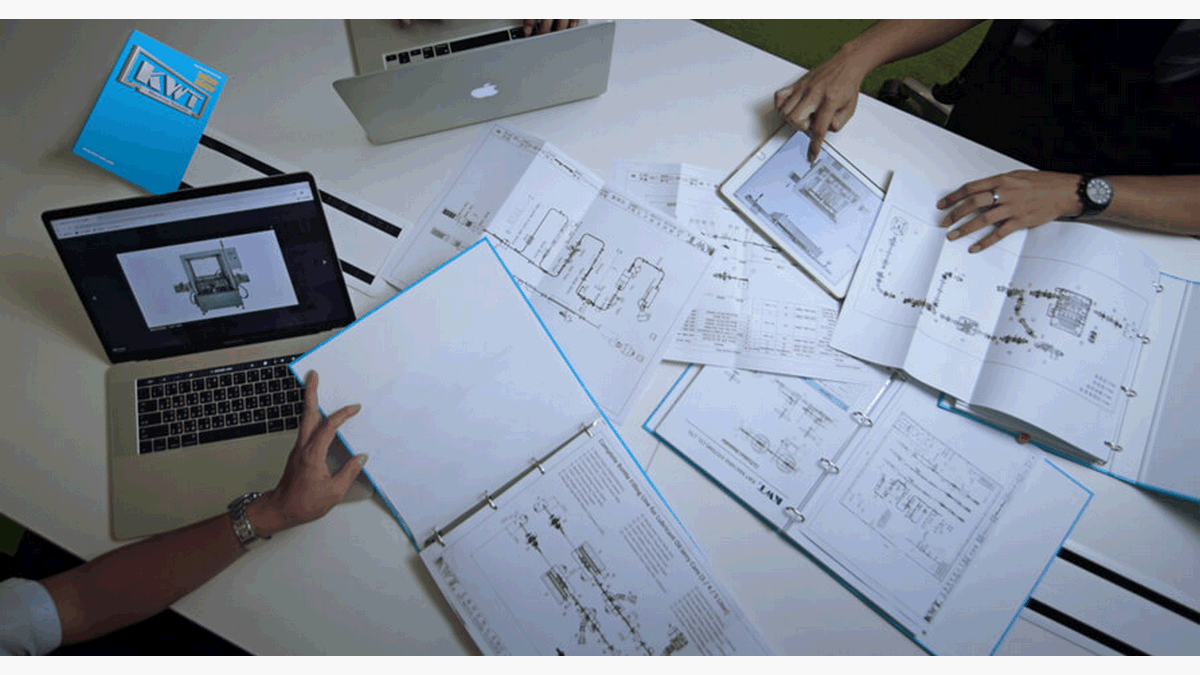
Advanced engineering projects benefit significantly from manufacturing expertise. Precision suppliers such as DMS Group Taiwan support complex material scaling by integrating early-stage DFM reviews, precision CNC machining, and rigorous production planning. In this sophisticated workflow, the goal is not only to machine the PEEK part correctly but also to optimize the design geometry for consistent, repeatable, and cost-effective mass production.
When PEEK Makes the Most Sense
PEEK is best suited for high-value applications where durability, dimensional stability, and chemical resistance outweigh the initial material cost premium. In short: it is the right choice when the total cost of component failure is higher than the price of the material itself.
For engineering and procurement teams evaluating advanced materials, the key is not only whether PEEK can perform, but whether it is the most efficient choice for the total life cycle of the application. When paired with proper DFM insights and expert CNC machining, PEEK remains one of the most reliable solutions for turning complex industrial challenges into high-performance realities.

(4059)(20260924)(原).jpg)
(2367)(20260924)(原).jpg)