Explore the mold and die industry, from its manufacturing supply chain and major applications to precision machining, automation, and digital manufacturing trends.
Molds and dies are fundamental tools in modern manufacturing. From automotive components and consumer electronics to household appliances, machinery, and plastic products, manufacturers rely on molds and dies to repeatedly produce parts with consistent shapes, dimensions, and quality.
For this reason, the mold and die industry is closely connected with the development of manufacturing as a whole. Improvements in mold design, machining accuracy, materials, and production technology can influence not only production efficiency but also product quality, development cycles, and manufacturers’ ability to produce increasingly complex components.
Understanding the mold and die industry therefore requires more than knowing what a mold is. It also involves understanding its position in the manufacturing supply chain, major applications, production technologies, and how the industry is evolving alongside modern manufacturing.
Why Is the Mold and Die Industry Important to Manufacturing?
Molds and dies are process tools used to repeatedly manufacture products or components with specific shapes and dimensions.
They are widely used across industries such as automotive, aerospace, electronics, electrical appliances, machinery, consumer products, chemicals, and building materials.
Their importance comes largely from their ability to support repeatable production. Once the appropriate tooling has been developed, manufacturers can produce large quantities of components while maintaining relatively consistent dimensions and product characteristics.
The quality of the mold or die can therefore directly influence:
- Product dimensional accuracy
- Surface quality
- Production efficiency
- Product consistency
- Tool life
- Manufacturing cost
- New product development time
As products become more complex and manufacturers demand tighter tolerances, mold and die capabilities also become an important part of overall manufacturing competitiveness.
Where Does the Mold and Die Industry Fit in the Manufacturing Supply Chain?
The mold and die industry connects materials, manufacturing equipment, tooling technology, product design, and mass production.
A simplified mold and die supply chain can be understood through several major areas.
Mold and Die Materials
The upstream supply chain provides the materials required to manufacture molds and dies.
Material selection depends on the production process, expected production volume, operating conditions, and required tool life.
Mold and die materials must often withstand repeated pressure, heat, friction, or impact during manufacturing. Their properties therefore affect durability, dimensional stability, maintenance requirements, and final product quality.
Mold Processing Equipment
Producing molds and dies requires high-precision machining equipment.
Depending on the tooling requirements, manufacturers may use technologies such as CNC machining, milling, grinding, electrical discharge machining (EDM), and wire cutting to create complex cavities, surfaces, and precision features.
As mold complexity and accuracy requirements increase, machining equipment and process control become increasingly important.
Mold Design and Engineering
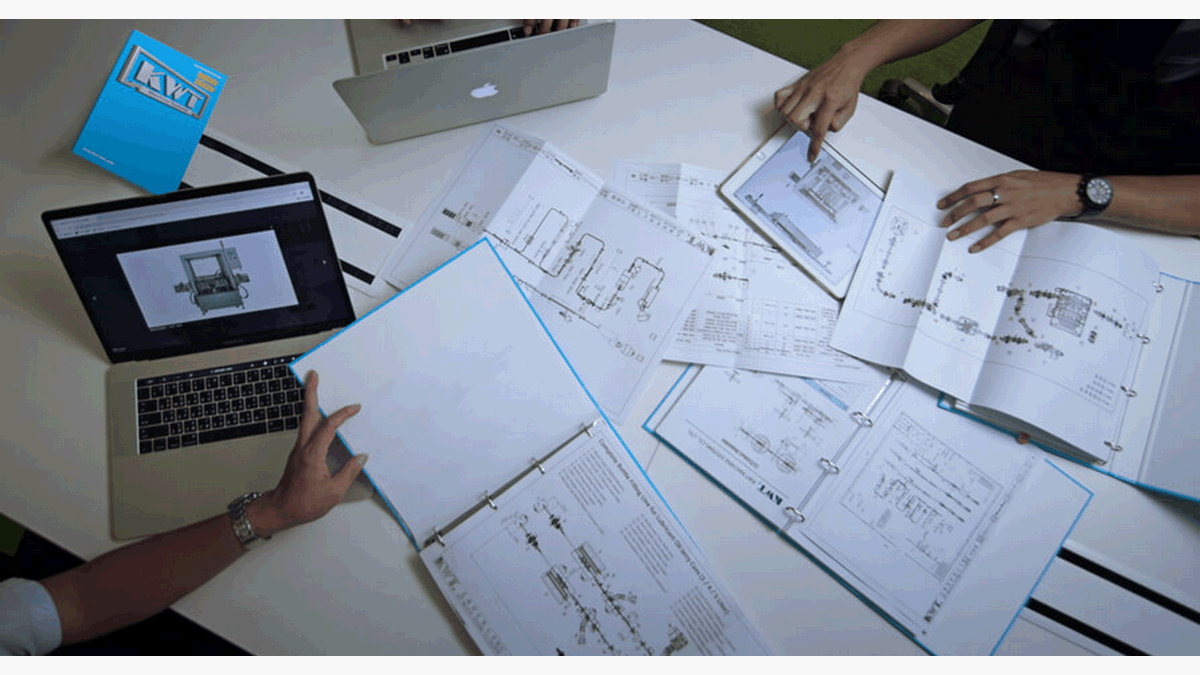
Before manufacturing begins, engineers must translate product requirements into a workable mold or die design.
The design process may consider:
- Product geometry
- Material characteristics
- Manufacturing process
- Parting lines
- Cooling requirements
- Ejection mechanisms
- Dimensional tolerances
- Expected production volume
- Maintenance and tool life
Modern mold development increasingly relies on CAD, CAM, and CAE technologies to support design, machining, and process simulation.
Molding and Mass Production
After the mold or die is manufactured, assembled, tested, and adjusted, it becomes part of the production system.
Depending on the application, tooling can be used with injection molding machines, die casting machines, stamping presses, forging equipment, extrusion lines, and other manufacturing systems.
The mold or die therefore serves as the connection between product design and repeatable mass production.
What Is the Difference Between a Mold and a Die?
Although the terms “mold” and “die” are sometimes used broadly, they can refer to different types of forming tools.
A mold is generally associated with processes in which a material is shaped while it is molten, liquid, or otherwise formable. Examples include plastic injection molds and die-casting molds.
A die, meanwhile, is commonly associated with processes that shape solid material through mechanical force. Examples include stamping dies, forging dies, and extrusion dies.
The distinction is useful for understanding the wide range of tooling technologies used across manufacturing.
However, both molds and dies serve a similar fundamental purpose: they provide a controlled shape or forming environment that allows manufacturers to repeatedly produce components according to specified requirements.
For a more detailed explanation of mold and die definitions, categories, and applications, see
What Is a Mold? Indispensable Tools in Industrial Manufacturing
.
What Are the Major Types of Molds and Dies?
Different manufacturing processes require different tooling.
Common examples include:
Plastic Molds
Plastic molds are used to form plastic products through processes such as injection molding, compression molding, blow molding, and other plastic forming methods.
Injection molds are particularly common in mass production because they can manufacture complex plastic parts with repeatable dimensions.
Die-Casting Molds
Die-casting molds are used to manufacture metal components by introducing molten metal into a mold cavity under pressure.
They are commonly associated with materials such as aluminum, zinc, and magnesium alloys and are widely used in automotive, electronics, machinery, and other industrial applications.
Stamping Dies
Stamping dies shape or cut sheet metal using mechanical force.
Depending on the required operation, stamping dies can perform processes such as blanking, punching, bending, and forming.
They are widely used in industries requiring large quantities of sheet-metal components.
Forging Dies
Forging dies shape metal by applying compressive forces.
Because forging can improve material flow and mechanical properties, forged components are commonly used in applications requiring strength and durability.
Extrusion Dies
Extrusion dies define the cross-sectional shape of material as it is pushed through the die.
Extrusion technology can be used to manufacture continuous products such as profiles, pipes, and other components with consistent cross-sectional shapes.
Powder Metallurgy Molds
Powder metallurgy molds are used to form powdered materials into specified shapes before subsequent processing or sintering.
This technology is useful for manufacturing components where material utilization, dimensional consistency, or complex geometry are important considerations.
What Industries Depend on Mold and Die Technology?
Because molds and dies support both metal and non-metal forming processes, their applications extend across a wide range of manufacturing industries.
Automotive Manufacturing
Automotive manufacturing relies heavily on tooling for vehicle body components, plastic interior and exterior parts, cast metal components, structural parts, and many other applications.
High production volumes and strict dimensional requirements make tooling quality particularly important in automotive production.
Electronics and Electrical Products
Molds are widely used to manufacture housings, connectors, structural components, and other precision parts found in electronic and electrical products.
As electronic devices become smaller and more complex, mold precision becomes increasingly important.
Machinery and Industrial Equipment
Industrial machinery requires a wide variety of cast, forged, stamped, extruded, and molded components.
Mold and die technologies therefore support the production of both individual machine components and larger manufacturing systems.
Consumer and Household Products
Plastic containers, appliance housings, household goods, packaging, and numerous everyday products rely on molds for efficient mass production.
Aerospace and High-Precision Manufacturing
Aerospace and other high-precision industries require components with demanding dimensional, material, and performance requirements.
These applications increase the importance of precision machining, advanced materials, quality control, and process simulation during mold and die development.
How Are Molds and Dies Manufactured?
Mold and die manufacturing typically involves several interconnected stages.
1. Product and Process Analysis
Manufacturers first evaluate the component design, material, production volume, dimensional requirements, and appropriate forming process.
This stage determines whether the product is suitable for molding or die-based production and establishes the basic tooling requirements.
2. Mold and Die Design
Engineers design the tooling structure according to the product and production requirements.
Digital design tools can help engineers evaluate geometry, tolerances, material flow, cooling, and other process considerations before physical manufacturing begins.
3. Precision Machining
The mold or die components are manufactured using appropriate machining technologies.
Complex tooling may require multiple processes, such as CNC milling, EDM, wire cutting, grinding, drilling, and finishing.
4. Assembly and Testing
After individual components are completed, the mold or die is assembled and installed for testing.
Trial production helps identify issues related to dimensions, material flow, surface quality, cooling, ejection, or other production conditions.
5. Adjustment and Production
Based on testing results, the tooling may be modified or fine-tuned before entering mass production.
Even after production begins, regular inspection and maintenance are important for maintaining tooling performance and extending service life.
How Is Technology Changing the Mold and Die Industry?
Modern mold and die manufacturing is becoming increasingly connected with digital and automated production technologies.
CAD, CAM, and CAE Integration
Computer-aided design and manufacturing technologies allow manufacturers to connect product design more closely with tooling development and machining.
CAE simulation can also help engineers evaluate manufacturing conditions before physical mold trials, potentially identifying issues earlier in the development process.
High-Precision CNC Machining
Advances in CNC machining enable manufacturers to produce increasingly complex mold geometries and tighter tolerances.
Improved machining accuracy can also reduce the amount of manual finishing required during mold production.
Automation
Automation is increasingly being introduced into machining, inspection, material handling, and molding processes.
By reducing repetitive manual operations, manufacturers can improve production consistency and respond more effectively to higher precision requirements.
Additive Manufacturing
Additive manufacturing is creating new possibilities for mold and die production, particularly in rapid tooling, prototypes, inserts, and components with complex internal structures.
Rather than replacing conventional mold manufacturing entirely, additive manufacturing can complement CNC machining and other traditional processes in suitable applications.
Digital Manufacturing and Process Simulation
Digital technologies are increasingly connecting mold design, machining, inspection, and production data.
This allows manufacturers to identify potential problems earlier, improve process visibility, and shorten the cycle between product development and mass production.
What Are the Key Trends in the Mold and Die Industry?
Several manufacturing trends are influencing the future development of mold and die production.
Higher precision requirements:
Industries such as automotive, electronics, and aerospace continue to demand increasingly accurate and complex components.
Shorter product development cycles:
Manufacturers face pressure to move from product design to production more quickly, increasing demand for faster mold design, machining, testing, and modification.
Greater product customization:
As markets move toward greater product variety and smaller production batches, tooling manufacturers need more flexible development and production capabilities.
Integrated manufacturing:
Mold design, precision machining, molding, surface treatment, assembly, and other services are increasingly being integrated to reduce coordination time and improve development efficiency.
Digitalization and automation:
CAD/CAM/CAE, automated machining, digital inspection, and production data management are becoming increasingly important for improving efficiency and consistency.
These trends are gradually changing mold manufacturing from an isolated tooling process into a more integrated part of digital manufacturing.
Mold and Die Technology as a Foundation of Modern Manufacturing
The mold and die industry plays a fundamental role in turning product designs into repeatable manufacturing processes.
From plastic injection molds and die-casting molds to stamping, forging, and extrusion dies, tooling technologies support production across automotive, electronics, machinery, consumer goods, aerospace, and many other industries.
At the same time, the industry is evolving beyond conventional mold manufacturing. Precision machining, CAD/CAM/CAE integration, automation, additive manufacturing, and digital production technologies are increasingly shaping how molds and dies are designed, manufactured, tested, and maintained.
As manufacturers continue to demand higher precision, shorter development cycles, and greater production flexibility, mold and die capabilities will remain an important part of manufacturing efficiency, product quality, and industrial competitiveness.



(4059)(20260924)(原).jpg)
(2367)(20260924)(原).jpg)