Creating SOPs is only the first step. Learn how manufacturers can reduce operational variation through clearer standards, consistent training, shop floor verification, and continuous improvement.
To stabilize product quality, improve production efficiency, and reduce variation caused by different operators, many manufacturers establish Standard Operating Procedures (SOPs), work instructions, equipment parameter standards, and quality specifications in the hope that every employee will complete tasks in the same way.
However, the reality on the shop floor is often very different. The same machine may be set up differently by different operators. Different shifts may develop their own work habits for the same process. Even when employees follow the same SOP, differences may still appear in yield, cycle time, and quality results.
This shows that having standards does not necessarily mean that work has truly been standardized.
The Lean Enterprise Institute considers Standardized Work an important method for reducing process variation, training new employees, and establishing a baseline for continuous improvement. The value of standardized work lies not merely in documenting the current process, but in creating a common operating baseline that different shifts can follow, compare, and improve.
Therefore, when a company has had SOPs in place for years but quality and productivity still depend heavily on individual operators, the real issue may not be whether employees are following instructions. Instead, the company should reconsider whether the standards are clear, whether they reflect actual shop floor conditions, and whether management has established mechanisms to verify and continuously improve those standards.
Why Do Operational Differences Still Occur Even When SOPs Are in Place?
Operational differences on the shop floor rarely result from a single employee failing to follow instructions. Employee experience, equipment condition, material variation, production environment, and management practices can all lead to different outcomes even under the same SOP.
One major factor is the difference in employee experience. Experienced operators often accumulate extensive knowledge of machine adjustments and abnormality handling. When they notice changes in material conditions, machine sounds, or product appearance, they may fine-tune the process based on experience. New employees, by contrast, tend to rely more heavily on written instructions or guidance from senior coworkers. Over time, different versions of the same operation may gradually emerge.
Different shifts may also develop their own operating habits. If day and night shifts are managed by different supervisors, and training methods or shop floor expectations are not fully aligned, each shift may eventually believe that its own way of working represents the “standard.”
Equipment condition is another factor that is often overlooked. Even if two machines are the same model, differences in age, component wear, maintenance condition, and calibration may mean that the same process parameters do not always produce identical results. If an SOP only specifies a fixed setting but does not define equipment condition or an acceptable adjustment range, operators may still need to rely on experience.
Raw materials can create similar challenges. Different material batches may show reasonable variation in hardness, viscosity, moisture content, dimensions, or surface condition. If the standard describes only ideal conditions without explaining how operators should respond to variation, different people will naturally develop different approaches.
Production pressure can also change how work is performed. When orders are urgent and delivery schedules are tight, operators may shorten confirmation steps, skip inspections, or adjust the work sequence. Although this may temporarily increase output, it can also increase quality variation and process risk.
These situations show that an SOP can define the intended method of work, but it cannot automatically eliminate every source of process variation. If a company only tells employees to “follow the SOP” without also managing equipment, materials, skills, and abnormal conditions, operational differences will continue.
The Problem May Not Be That Employees Fail to Follow the SOP, but That the Standard Is Difficult to Execute
When operational differences appear, the most direct management response is often to retrain employees or assume that operators failed to follow the rules. However, if the same deviation repeatedly occurs across different employees and shifts, the company should ask a different question: Is the standard itself difficult to execute?
One common problem is that the SOP is extremely comprehensive but impractical on the shop floor.
Some SOPs run dozens of pages and contain large amounts of text, tables, and technical explanations. They may be excellent for audits, but operators cannot easily check the next required step during production. As a result, new employees may carefully read the documents, while experienced workers rely primarily on memory and practical experience.
A second problem is that critical operating conditions are not clearly defined. Instructions such as “adjust pressure appropriately,” “confirm that appearance is normal,” or “adjust speed according to actual conditions” appear flexible, but they transfer most of the judgment to individual operators. Different people naturally interpret “appropriate” and “normal” differently.
An effective standard should therefore explain not only what to do, but also the critical operating conditions, acceptable ranges, and what actions should be taken when abnormalities occur.
A third problem is that SOP updates do not keep pace with shop floor changes.
Manufacturers frequently improve fixtures, replace equipment, change materials, modify product designs, or optimize processes. However, shop floor improvements are not always reflected in the documentation immediately. Several months later, the official SOP may still describe the old process, experienced employees may use the improved process, while new employees continue learning from the outdated document.
At that point, the company no longer has one standard. It has a documented standard and an actual operating standard.
Toyota’s historical records show that when standardized work was established, it was not limited to creating work instruction documents. Toyota also clearly defined takt time, work sequence, and standard work-in-process while incorporating equipment and material arrangement into work design. This reflects the broader Toyota approach to standardization: an integrated design of people, equipment, materials, and work sequence rather than a standalone SOP.
Toyota continues to treat continuous improvement as a core principle of the Toyota Production System. Its official materials emphasize making work easier to perform while using daily Kaizen by all employees to eliminate waste, shorten lead times, and improve quality.
In other words, mature standardization does not mean “once the rule is written, it can never change.” It means establishing the best-known current method and continuously refining it based on actual shop floor results.
How Can Companies Make Standards Work on the Shop Floor?
To close the gap between documented requirements and actual execution, companies first need to make standards easy to understand, easy to perform, and easy to verify.
One of the most direct approaches is to visualize critical work.
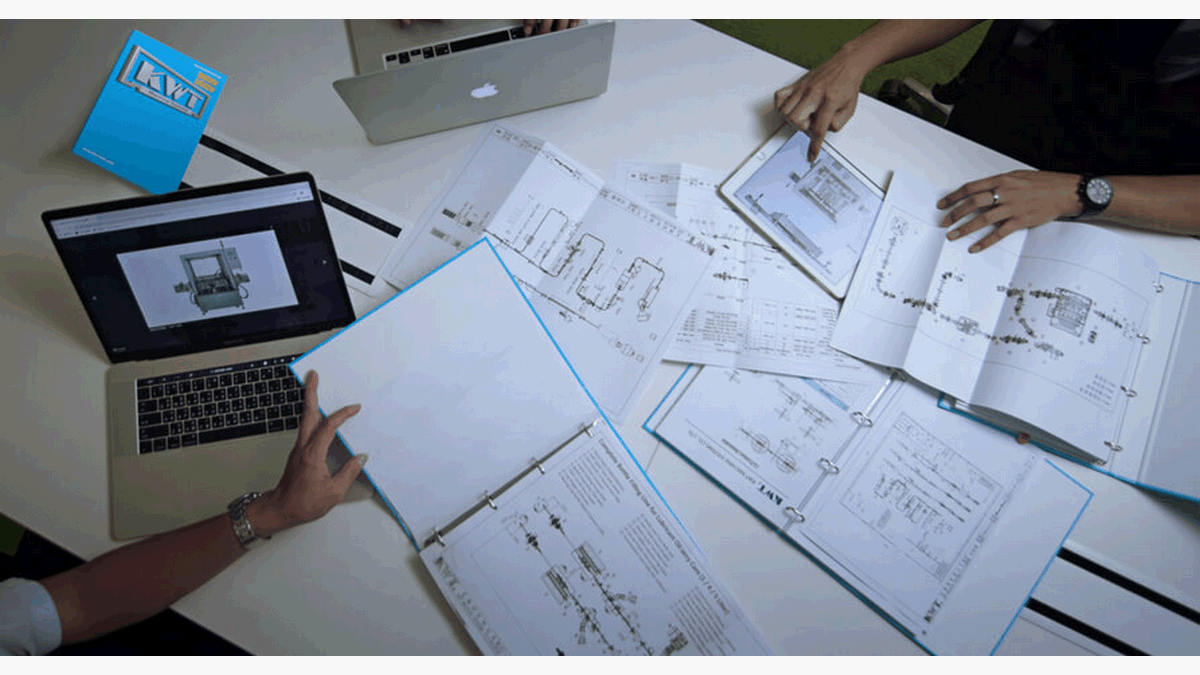
Instead of requiring operators to search through text-heavy documents during production, manufacturers can convert key work sequences, equipment parameters, quality criteria, tool locations, and abnormality response procedures into photographs, illustrations, flowcharts, color coding, or short videos. At critical workstations, the latest work instructions can also be made directly available so employees can check them immediately when needed.
Improving documents, however, is only the first step. More important is establishing a consistent training method.
One of the biggest standardization problems in many factories is not the absence of SOPs, but the fact that every new employee is trained by a different experienced worker. One mentor teaches one method, another teaches something different, and in the end employees learn individual experience rather than the company standard.
Training therefore needs to include competency verification. Completing a training session does not necessarily mean an employee can perform the task correctly. Practical demonstrations, verification of critical steps, and skills assessments should be used to confirm that employees can consistently execute the standard.
Toyota has long incorporated concepts related to Training Within Industry (TWI) into employee development. Its training system has also included areas such as Standard Work and Improvement and Job Training Methods, demonstrating that standardized work and job instruction are closely connected management mechanisms.
Shop floor supervisors and team leaders also play a critical role.
Standardization cannot be managed entirely by quality departments or engineers. Team leaders are usually the people most likely to observe daily deviations, including changes in work sequence, tools not being returned to their designated locations, equipment parameters drifting from standards, or employees skipping steps to meet output targets.
Companies can use daily shop floor checks, first-piece confirmation, or simple process audits to identify the gap between standards and actual work early. Managers should not only ask, “Why didn’t you follow the procedure?” They should also ask, “Why did the shop floor choose a different method?”
Sometimes, deviation means an employee needs retraining. In other cases, it may mean that the employee has discovered a more efficient method or that the original standard no longer fits current equipment or production conditions.
For this reason, abnormality reporting should also be part of the standardization system. When employees discover that an SOP cannot be executed, equipment conditions have changed, or material characteristics differ, they should have a clear way to report the issue instead of creating an unofficial “shadow standard.”
From Toyota to Smaller Manufacturers: What Does Standardization Really Improve?
Toyota is one of the most widely recognized examples of standardized work and continuous improvement. However, the key lesson is not simply that “everyone follows the rules.” It is that the company establishes a common baseline and then allows the shop floor to continuously identify problems and improve.
The Toyota Production System emphasizes Jidoka, which means making abnormalities immediately visible and addressing them when they occur. Toyota’s official materials explain that employees on the production line are responsible for stopping the process and responding when abnormalities are found, preventing defects from flowing downstream and using continuous improvement to reduce waste and rework.
This differs from the traditional idea that “an SOP must never be violated.” The purpose of the standard is not to hide problems, but to define what normal looks like so that deviations become easier to identify.
Standardization is also not limited to large manufacturers.
The NIST Manufacturing Extension Partnership has published a Lean Transformation case involving Dakota Bodies. After implementing improvement initiatives, the company established standardized work alongside employee training and shop floor management. The result was shorter training time, more consistent operations, and improved product quality.
In another NIST MEP case, Island Components implemented lean process improvement and increased daily output from 75 units to 120 units while reducing work-in-process inventory from 717 units to 156 units.
The important lesson from these cases is not that one SOP directly created more capacity. Rather, process analysis, workforce training, and standardized work combined to make the overall manufacturing process more stable.
This demonstrates that the business value of standardization goes beyond making everyone’s movements look the same.
When processes become more stable, companies can estimate standard labor time and capacity more accurately. When new employees are trained using consistent methods, knowledge transfer no longer depends entirely on a small number of experienced workers. When quality conditions are clearly defined, abnormalities are easier to identify and trace.
Stable standardized processes are also an important foundation for manufacturers introducing MES, automation equipment, AI vision inspection, or smart manufacturing. NIST notes that smart manufacturing requires information technology and operational technology to be connected across the value chain. If shop floor processes remain highly inconsistent, collecting more data will not necessarily produce stable or comparable management information.
Standardization is therefore not an outdated management approach that comes before smart manufacturing. It is an important foundation for further digitalization and automation.
How Can Companies Move from “Following Standards” to “Continuously Improving Standards”?
One of the most common misunderstandings about standardization is the belief that once a standard is created, it should remain unchanged forever.
However, if products, materials, equipment, and market demands continue to evolve, production standards cannot remain permanently fixed.
The Lean Enterprise Institute considers standardized work a foundation for Kaizen. Once a standard exists, the shop floor can clearly understand the current method, identify variation, and determine whether a new method is genuinely better than the existing one.
Companies should therefore establish a cycle of:
Execute the standard → Identify differences → Analyze the cause → Improve the process → Update the standard → Verify again.
For example, if one shift consistently completes changeovers faster than other shifts, managers should not simply tell everyone else to “work faster.” Instead, they should observe whether that shift uses a better tool layout, preparation method, or work sequence.
If the method genuinely reduces changeover time without compromising safety or quality, it should become the new common standard.
Conversely, if one shift has a significantly higher defect rate, the same common standard can be used to compare actual operating differences and determine whether the problem originates from people, equipment, materials, or process conditions.
This is one of the most important purposes of standardization: without a common baseline, it is difficult to determine where variation actually comes from.
Companies can also use quality data, production cycle time, rework rates, first-pass yield, and abnormality records to continuously verify whether standards remain effective.
When shop floor conditions change or a better method has been proven, work instructions and training materials should be updated at the same time. Otherwise, the improved method may remain only in the experience of a few senior employees.
NIST considers Value Stream Mapping and continuous lean process improvement important approaches for helping manufacturers identify waste, diagnose problems, and improve productivity. The underlying idea is not one-time improvement, but continuous measurement and process review.
A mature standardization culture therefore does not require employees to “work only according to the document.” Instead, it establishes the best-known current method that everyone can follow while allowing verified improvements to become the next version of the standard.
True Standardization Makes Shop Floor Results Stable—and Continuously Improveable
When operational differences remain after SOPs have been established, it does not necessarily mean employees are unwilling to follow procedures.
The problem may come from unclear standards, documentation that no longer reflects shop floor reality, inconsistent training, or changes in equipment, materials, and operating conditions.
Effective production process standardization must address four questions at the same time: How is the standard defined? How are employees trained? How do supervisors verify execution? How are abnormalities fed back into the system?
Standardization becomes effective when different shifts and operators can consistently achieve similar levels of quality and productivity under the same operating conditions.
More importantly, standards should not become barriers to improvement. They should become the starting point for improvement. Only when companies understand the best current method can they objectively determine whether a new approach is safer, more efficient, and more stable—and then turn successful improvements into capabilities that can be replicated across the organization.
For manufacturers, the competitive value of standardization is not limited to reducing differences between operators. It also reduces dependence on individual employees for quality, productivity, and technical knowledge.
When good operating methods can be understood, executed, verified, and continuously updated, manufacturers can build a production system that is more stable, easier to scale, and better prepared for automation and smart manufacturing.


(4059)(20260924)(原).jpg)
(2367)(20260924)(原).jpg)