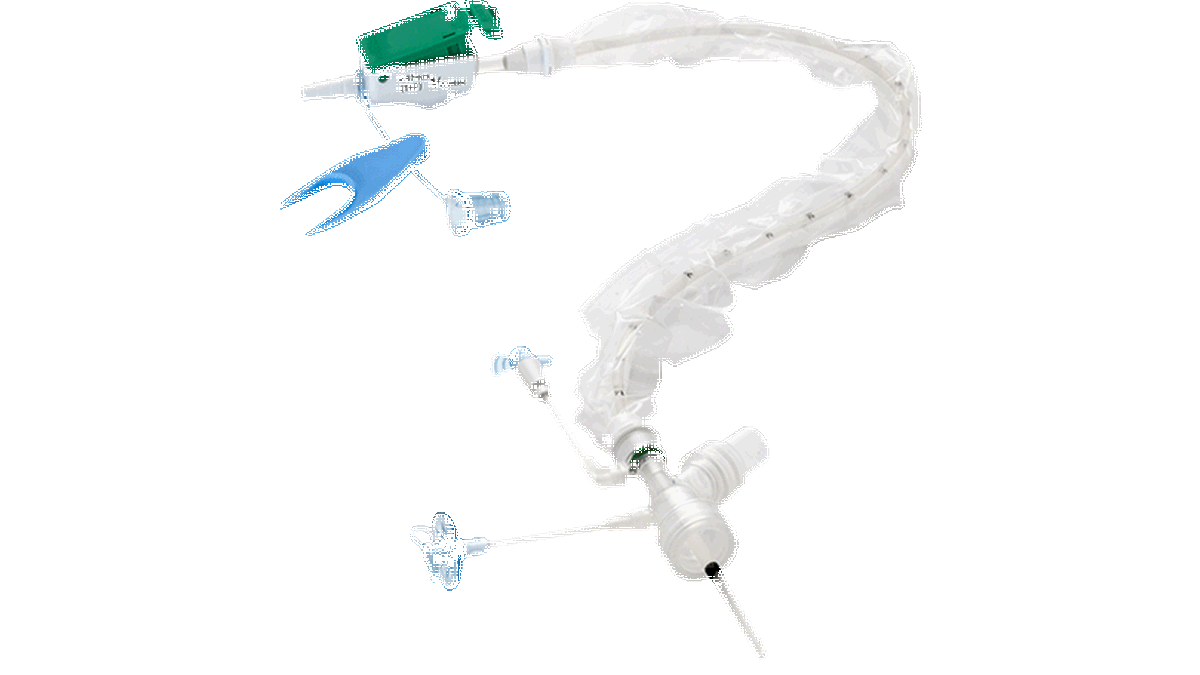
Closed suction systems are designed to allow airway secretions to be removed from mechanically ventilated patients without routinely disconnecting the ventilator circuit.
A suction catheter enclosed within a protective sleeve forms part of the connected assembly, allowing suctioning to be performed while maintaining the circuit connection.
Although closed suction systems share this basic operating principle, their component configurations and handling mechanisms can vary. Suction controls, isolation valves, irrigation arrangements, and catheter specifications are among the features that should be considered when evaluating different products.
Understanding these design elements helps medical device distributors and procurement teams assess product configurations based on their intended applications and operating requirements.
For an overview of the technology, see Closed Suction System: Revolutionizing Respiratory Care.
Key Design Features of Closed Suction Systems
Protective Sleeves and Catheter Enclosure
The protective sleeve is a fundamental component of a closed suction system. It encloses the suction catheter and allows the catheter to be advanced and withdrawn without direct handling of the enclosed portion.
This arrangement provides a physical barrier between the catheter and the surrounding environment during normal operation.
When evaluating different systems, it is important to consider the protective sleeve as part of the complete catheter assembly, including its connection to adjacent components and the manufacturer's specified operating procedure.
Ergonomic Suction Control Mechanisms
The suction control mechanism allows suction to be activated and released during the procedure. Different closed suction systems may incorporate control switches with varying designs and operating methods.
Some configurations feature ergonomically designed switches intended for single-handed operation. This is a handling characteristic that may be relevant when reviewing product usability.
The location and operating method of the suction control should be assessed according to the manufacturer's instructions for use. Features such as single-handed operation describe how a device is intended to be handled and should not be interpreted as evidence of improved clinical outcomes.
Isolation Valves and Irrigation Chamber Design
Certain closed suction systems incorporate isolation valves within their irrigation arrangements.
Depending on the product configuration, an isolation valve may be used to separate the irrigation chamber from another part of the system during specified operating steps. Some designs also incorporate mechanisms intended to limit fluid backflow.
Isolation valves can differ in their placement and operating methods. These differences should be understood through the manufacturer's product documentation rather than assuming that one valve arrangement is universally preferable.
The irrigation chamber and valve mechanism should therefore be evaluated together, with particular attention to their intended functions and operating instructions.
Catheter Identification and Connection Configurations
Closed suction systems are available with different catheter sizes, lengths, and connection arrangements. These specifications must be considered in relation to the intended airway equipment.
Some products incorporate color-coded components to assist with catheter size identification. Color coding provides an additional visual reference, but product labels and specifications remain essential for confirming the appropriate configuration.
Connection compatibility is another important consideration. Distributors should verify the intended equipment connections using the manufacturer's documentation rather than assuming that all closed suction systems are interchangeable.
What Matters When Comparing Closed Suction Systems?
Beyond individual design features, closed suction systems should be evaluated according to their complete specifications and intended use.
Catheter specifications: Catheter size and length should correspond to the intended airway equipment and application. Available configurations may differ between products designed for endotracheal and tracheostomy use.
Recommended duration of use: Manufacturers may specify different recommended usage periods for their products. These designations should be interpreted according to the applicable instructions for use and do not independently establish differences in clinical performance.
Operating mechanisms: Suction controls, isolation valves, and irrigation arrangements should be reviewed as part of the complete system. Understanding the required operating steps is important when comparing product configurations.
Technical documentation: Product specifications, instructions for use, and compatibility information provide essential references for distributors and procurement teams. These materials help clarify the intended functions and limitations of individual devices.
A comparison based on these factors provides a more useful understanding of product differences than relying solely on individual features or general descriptions of product quality.
How Design Considerations Appear in Commercial Products
Manufacturers may incorporate these design elements in different ways depending on the intended product configuration.
For example, Vitaltec's Closed Suction Systems include models with ergonomic suction controls, isolation valves, and color-coded catheter identification. Its Vital-Cath 72hr Plus and C-Bona 72hr systems illustrate different approaches to valve configuration and component design.
These examples demonstrate how individual design features can be incorporated into commercially available systems. Their suitability should be assessed according to the intended application and the manufacturer's product specifications.
Understanding Closed Suction System Design
Closed suction systems share a common operating principle, but differences in component design and product specifications remain relevant when comparing available configurations.
Protective sleeves, suction controls, isolation valves, and catheter identification features each serve specific functions within the system. Understanding these functions, together with the intended application and technical documentation, provides a practical basis for informed product evaluation.