Why the Modern CNC Wood Machine Has Become a Strategic Production Asset
In woodworking and furniture manufacturing, competitive advantage is no longer defined by craftsmanship alone. Today, production speed, consistency, labor efficiency, and the ability to respond to custom orders are becoming just as important. For factory owners, procurement managers, and production leaders, this is why the modern cnc woodworking machine is increasingly seen as a strategic investment rather than just another piece of equipment.
Across the global manufacturing sector, leading woodworking machinery suppliers are moving in the same direction: higher automation, stronger digital control, and closer integration between design, machining, and downstream processes. In practical terms, this means a modern cnc wood machine is no longer simply a cutting tool. It is a core part of a production system that helps reduce setup time, improve material utilization, and support more flexible manufacturing.
What Is Changing in the Global Woodworking Machinery Market?
From furniture and cabinets to interior components and value-added wood products, market demand is shifting toward higher precision, shorter lead times, and more customized production. This means factories can no longer rely only on manual setup, operator experience, and fixed production patterns. Instead, they need more predictable processes and more stable output.
Three major factors are driving this shift.
First, the industry continues to face labor shortages and skills gaps. Experienced woodworking operators are harder to recruit and retain, and training new talent takes time. When production depends too heavily on a small number of skilled workers, operational risk increases.
Second, customization is becoming a mainstream requirement. Buyers increasingly expect fast delivery, smaller batch sizes, and greater product variety. In many segments, “batch size one” is no longer a niche concept. It is becoming part of normal production expectations.
Third, raw material costs and margin pressure are forcing manufacturers to reduce waste. When panel and wood costs rise, every cutting error, setup mistake, and unnecessary offcut directly affects profitability. This is where a modern woodworking cnc machine can make a measurable difference through more accurate cutting, better nesting, and more consistent machining.
Taken together, these changes explain why smart automation is no longer viewed as optional in many parts of the industry. It is increasingly becoming the new operating standard.
Why Smart Automation Is Becoming the New Standard
Smart automation is gaining ground not because it sounds advanced, but because it solves real production problems. In many woodworking factories, the biggest challenges are not theoretical. They are setup delays, inconsistent quality, labor shortages, scattered production data, and limited coordination between different stages of manufacturing.
That is why the role of the cnc wood machine is changing. It is no longer just a standalone machine performing one task. It is becoming part of a larger manufacturing system that can support better planning, better repeatability, and better overall control.
In practical terms, smart automation can help manufacturers:
- reduce manual setup and adjustment time
- improve repeatability across different shifts and batches
- support smoother transitions between product variations
- create a stronger foundation for future loading, unloading, sanding, or line integration
- move toward more data-driven maintenance and production management
This direction is also reflected in the strategies of international brands such as HOMAG and SCM, which continue to invest in automation, software integration, and connected production. The market is increasingly moving from “buying a machine” to “building a smarter production capability.”
What Should Buyers Look for in a Modern CNC Wood Machine?
For procurement teams and factory managers, machine evaluation should go beyond price and basic specifications. The more important question is whether the equipment can improve the full production workflow.
1. Setup and changeover efficiency
If every product change requires manual repositioning, repeated trial cuts, and heavy operator intervention, then hidden costs can quickly outweigh any initial savings. A more advanced cnc woodworking machine should help shorten the time between jobs and make setup more efficient.
2. Stability during continuous production
True performance is not just about machining one accurate part. It is about producing many parts consistently over time. This matters especially in panel processing, curved parts, shaped components, and multi-face machining, where stability directly affects downstream assembly and finishing quality.
3. Integration and upgrade potential
A machine that cannot work smoothly with CAD/CAM software, nesting workflows, or future automation plans may become a bottleneck later. That is why buyers increasingly pay attention to whether a Wood CNC Machining Center can support both current production needs and future expansion.
How Does Traditional Production Compare with Smart CNC Production?
The table below highlights why more manufacturers are treating smart equipment as a practical upgrade path. This does not mean every factory must immediately adopt a fully automated line. It does show, however, that industry standards are changing.
| Production Factor |
Traditional Workflow |
Smart CNC Workflow |
| Setup and changeover |
Heavy manual adjustment, longer preparation time |
Program-driven workflow with shorter setup time |
| Labor dependence |
High reliance on experienced operators |
Operators shift more toward supervision and process control |
| Machining consistency |
More variation between people or shifts |
Higher repeatability and process stability |
| Custom order flexibility |
Slower response to product variation |
Better support for mixed orders and small batches |
| Material utilization |
Greater risk of waste from manual error |
Better optimization through nesting and process control |
| Production management |
Information is often fragmented |
Easier to move toward digital management |
The key takeaway is not that traditional methods have no place. It is that manufacturers increasingly need more controllable, scalable, and adaptable production systems.
Why Are 5-Axis and Multi-Axis Machines Receiving More Attention?
As furniture design and wood product applications become more complex, multi-axis capability is becoming more valuable. A 3-axis machine remains highly effective for many flat-panel applications. However, when parts involve curves, angled surfaces, multiple faces, or more advanced shaping, a multi-axis cnc wood machine can provide clear advantages.
For manufacturers producing chairs, tables, shaped furniture components, custom wood parts, or other high-value products, fewer setups can mean lower labor input, less positioning error, and better cycle efficiency. This is one reason why multi-axis equipment is attracting growing interest from companies looking to move into higher-margin production.
Where Does the Real ROI of Automation Come From?
When factories consider upgrading equipment, return on investment is often the biggest concern. In practice, the ROI of smart equipment usually comes from several improvements combined rather than one dramatic change.
These gains often include:
- reduced setup and waiting time
- lower material waste and rework
- improved production stability
- less dependence on a small number of highly experienced operators
- greater ability to take on more complex and higher-value jobs
For this reason, many manufacturers do not move to full automation all at once. A more realistic approach is often to begin with a higher-capability cnc woodworking machine or Wood CNC Machining Center, then expand step by step as production needs evolve.
FAQ: Common Questions from Procurement and Production Teams
Q1: What is the biggest practical benefit of a modern cnc woodworking machine?
A1: The main benefit is improved overall production efficiency. This includes faster setup, more stable machining quality, better material use, and stronger flexibility for custom or mixed-order production.
Q2: Is a 5-axis cnc wood machine always a better investment than a 3-axis machine?
A2: Not always. A 3-axis machine is still highly effective for many panel-based applications. But if the factory handles curved parts, angled cuts, complex geometries, or multi-face processing, a 5-axis machine often delivers greater long-term value.
Q3: Does adopting smart equipment mean replacing the whole production line at once?
A3: No. Many factories upgrade in stages, starting with core machining capacity and then adding automation or digital management functions over time.
What Kind of Supplier Is the Market Looking for?
As the woodworking industry upgrades, expectations of suppliers are also changing. Buyers are no longer focused only on machine price. They increasingly look for suppliers that understand woodworking applications, can provide stable structural design, and offer solutions that match different production scenarios.
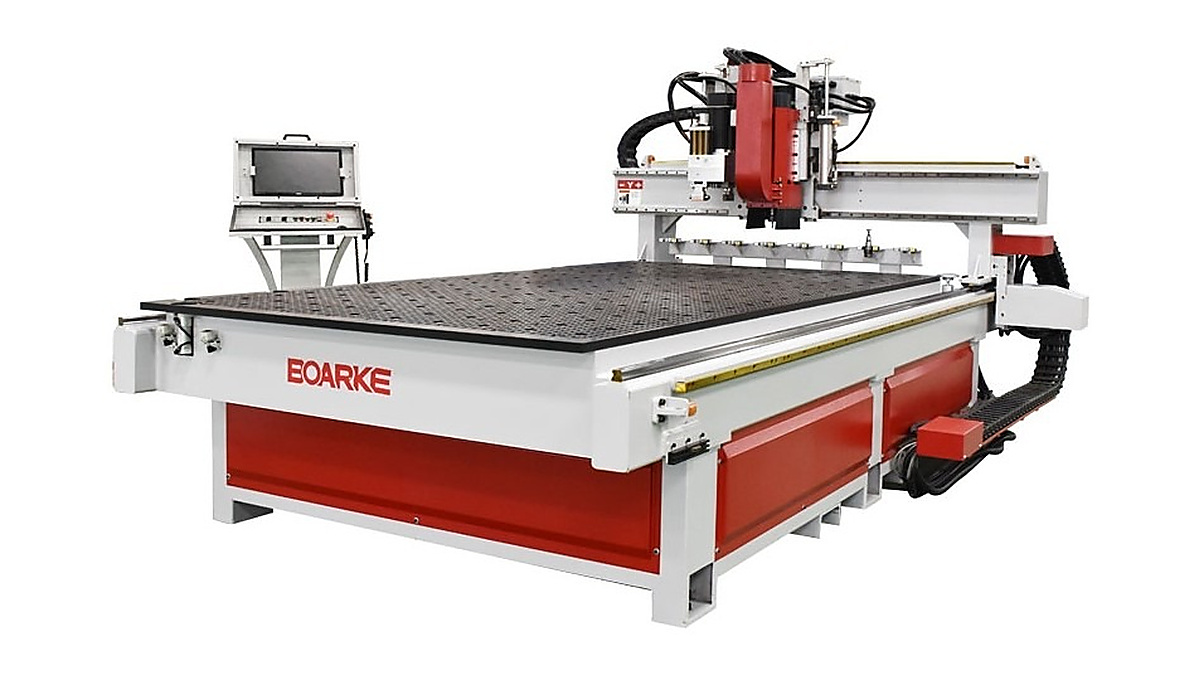
Among Taiwanese suppliers, Boarke Machine Co., Ltd. is one company worth noting. Based on its public information, the company has more than 30 years of experience in CNC woodworking machinery and offers a range of 3-axis, 5-axis, and 6-axis solutions, including multiple Wood CNC Machining Center models designed for different machining needs.
Conclusion
The global woodworking machinery market is moving toward a clearer standard: smarter, more connected, and more flexible production. This shift is being driven by labor shortages, margin pressure, customization demands, and the need for more stable output. In that environment, the modern cnc wood machine is becoming a key part of how manufacturers stay competitive.
For decision-makers, the goal is not to chase the most advanced specification on paper. It is to choose equipment that improves today’s production efficiency while supporting tomorrow’s growth. For those who want to evaluate suitable machine options in more detail, Boarke’s product information may serve as a useful reference, and direct technical consultation, contact Boarke today.




(3796)(20260924)(原).jpg)